

Fast Insight into Composition and Freshness
Milk and dairy production depend on one essential factor: consistent quality. From the farm to final processing, every step requires a clear understanding of what is in your product. This is where EasyDens and pH2Go come together. As a combined approach, they deliver fast, reliable insights into both composition and product condition - two key dimensions of milk quality. Density measurement provides a clear view of the overall composition, making even small changes in fat, protein, lactose, or water content immediately visible. At the same time, pH measurement indicates freshness and microbiological status. Together, they help you detect dilution, identify early spoilage, and spot process inconsistencies at an early stage. With real-time measurements, you can screen quality instantly, respond faster, and keep your process under control.
Reliable Quality Control – Wherever Milk Quality Matters

EasyDens milk measurement

pH2Go milk measurement

On-Farm Testing: Insight Right Where It Starts
Right after milking, raw milk is collected, cooled, and stored before transport. At this early stage, density and pH provide fast, meaningful insight into milk quality. Density measurement with EasyDens reveals the overall composition, helping detect irregularities such as unusual solids content or potential dilution. At the same time, pH measurement with pH2Go indicates freshness and can uncover early microbial activity directly on-site. Together, these parameters create a reliable first quality check before the milk even enters the supply chain.

Incoming Goods Inspection: Fast, Reliable Decisions
At raw milk reception, milk is unloaded, sampled, and prepared for processing. This is where quality decisions matter most. Combining density and pH measurement gives you a clear and complete snapshot of the raw material. EasyDens highlights deviations such as dilution or inconsistencies, while pH2Go confirms whether the milk is within the expected freshness range.

In-Process Control: Consistency in Every Step
During processing, from cream separation and fat standardization to homogenization and pasteurization, consistency is key. Density and pH act as complementary process indicators. EasyDens enables real-time monitoring of composition, ensuring products stay within defined ranges. At the same time, pH2Go becomes essential in processes like fermentation and cheese production, where pH directly affects texture, taste, and stability.

Final Product Verification: A Reliable Final Check
Before distribution, products such as milk, cream, or yogurt must meet clearly defined specifications. A combined check of density and pH strengthens final quality control. EasyDens provides a fast plausibility check for product consistency, while pH2Go confirms stability, shelf life, and compliance with quality standards. A simple, effective cross-check right before release.
Smart Tools for Dairy Quality Control

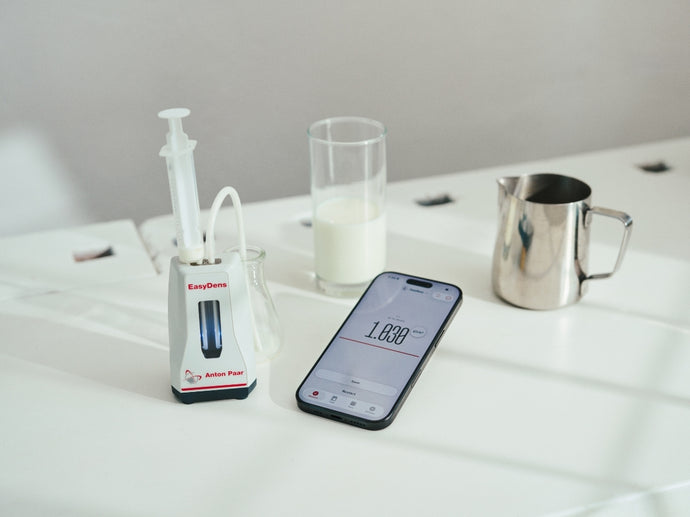
EasyDens Digital Density Meter
- Lab-grade density readings for milk and cream
- Density ranges from 0.700 to 1.200 g/cm³ - ideal for dairy applications
- Only 2 mL sample volume required for efficient testing
- Automatic temperature compensation aligned with global standards

pH2Go: Digital pH Meter
- Glass-free pH sensor for safe use in food production areas
- Compact, portable design for flexible on-site measurement
- Fast response for immediate quality assessment
- Easy-to-clean for efficient use in food applications
Lab Meister App: Dairy Quality, Organized
Start measurements in seconds and view results clearly in your preferred units - intuitive, and ready for everyday use. All calculations, including temperature compensation, run automatically in real time. Every reading is organized in structured logs for clear documentation and long-term analysis. Export to print-ready PDF for audits, or internal QC reports, or to CSV for deeper analysis in your own systems. Measurements sync across iOS, Android, and web through Meister Cloud. The QC lead checks today's incoming goods on a phone, the plant manager reviews the week on a desktop, and last quarter's data is always one search away. Track trends, verify incoming goods, and keep quality consistent across every shift, site, and supplier.
Key Measurement Units for Dairy Quality Control
EasyDens Measuring Units for Milk:
- Milk Density (g/cm³ @15.5) (g/cm³ @20) (g/cm³ @21) (g/cm³ @27)
- Cream Density (g/cm³ @15.5) (g/cm³ @20) (g/cm³ @21) (g/cm³ @27)
- Temperature (°C/°F)
pH2Go Measuring Units for Dairy:
- pH value
- Temperature (°C/°F)
FAQs
Why is density important for milk quality control?
Density reflects the balance of water, fat, proteins, and dissolved solids of milk. If values move outside the expected range, it can point to dilution or inconsistencies. That makes density a fast, reliable screening tool for everyday quality control.
Why is pH important for milk quality control?
pH reveals the freshness and microbiological condition of milk. Stable values indicate fresh, high-quality products. Deviations can signal bacterial activity or early spoilage. With pH, you get a quick and reliable check that supports confident quality decisions.
What is the typical density of fresh milk?
Fresh milk typically has a density between 1.028 and 1.034 g/cm³ at 20 °C (68°F). This range reflects the natural balance of water, fat, proteins, lactose, and minerals.
Values outside this range can point to dilution or shifts in fat and solids content.
Do I need to control temperature during density measurement?
Yes, temperature directly affects density. To ensure results are comparable, measurements must be referenced to a defined temperature. EasyDens handles this automatically with built-in temperature compensation, delivering consistent, ready-to-use results without extra steps.
How does pH measurement support dairy processing?
pH is a key control parameter across dairy processes. It influences protein behavior, enzyme activity, and microbial growth ̶ factors that shape texture, taste, and stability.
In fermentation, precise pH control ensures cultures develop as expected and deliver consistent flavor. In cheese production, it is essential for coagulation, whey separation, and final structure. Even small deviations can lead to texture defects, reduced shelf life, or batch inconsistencies.
Continuous pH monitoring keeps your process within target ranges, enables fast adjustments, and ensures reproducible, high-quality results.
What is the typical pH range of fresh milk?
Fresh milk typically has a pH between 6.6 and 6.8. A drop below this range can indicate increasing bacterial activity and early acidification ̶ making pH a valuable early warning signal in quality control.
Explore our devices and improve your dairy quality