
Control the Process, Perfect the Batch.
Producing your own spirits and liqueurs goes beyond craft - it’s about making informed decisions at every step. From fermentation to distillation and final blending, knowing the exact alcohol content gives you full control over your process and your results. With clear insight into key parameters like ABV (alcohol by volume), you can refine recipes with confidence, reduce variability, and consistently achieve the quality you’re aiming for. Fast, reliable measurements replace guesswork and eliminate the need for time-consuming traditional methods. The results: consistent quality, efficient workflows, and the flexibility to experiment - while staying in control from the first step to the final product.
Precision at Every Step - From Mash to Finished Spirits and Liqueurs

ABV measurement with the Alcohol Meter for liqueurs

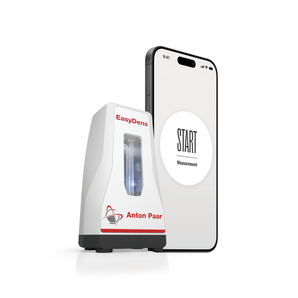
ABV measurement with EasyDens for sugar-free spirits

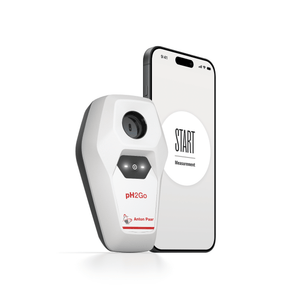
pH during mashing with pH2Go

Mashing & Fermentation: The Foundation of Every Spirit
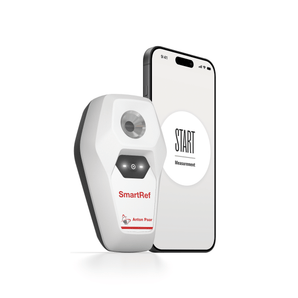
Before fermentation begins, mashing is a crucial step in spirit production. During mashing, starches are converted into fermentable sugars, creating the foundation for efficient fermentation and consistent alcohol yield. Proper pH control with pH2Go at this stage is especially important, as it supports enzyme activity, helps prevent unwanted harshness, and reduces the risk of microbial issues. Fermentation is the next critical step in spirit production, where sugars are converted into alcohol by yeast. The quality and consistency of fermentation directly shape the final product. Keeping pH within the optimal range of pH 4.0 to 4.5 supports stable yeast activity and can be continuously monitored with pH2Go. At the same time, tracking the decrease in sugar content in Brix with EasyDens or SmartRef gives you real-time insight into fermentation progress - so you know exactly when fermentation is complete.

Distillation: Precision at Every Cut
After fermentation, the mash is distilled to separate and concentrate the alcohol through heating and condensation. The distillate is collected in fractions - foreshots, heads, hearts, and tails - each with distinct characteristics. Making the right cut at the right time is essential. By monitoring ABV with the EasyDens throughout the process, you gain clearer insights to make more informed decisions - ensuring only the desired heart fraction is collected. After distillation, ABV measurement with EasyDens allows you to verify and adjust the final strength with confidence.

Liqueur Production: Confidence in Complex Formulations
Liqueur production builds on distilled spirits by adding sugar, flavors, and other ingredients. Flavors are introduced through maceration, infusion, or similar techniques before sweetness is adjusted. Measuring ABV with the Alcohol Meter ensures that the ABV level stays exactly where it should be. Finding the right balance between ABV, sugar, and extract is key - it defines taste, mouthfeel, and overall consistency. With the right measurements in place, you can refine your formulation and achieve desired results every time.
Smart Tools for Craft Distillers and Liqueur Producers

Digital Alcohol Meter
Accurate ABV measurement for finished liqueurs.
- ±0.6 %v/v accuracy
- No distillation required

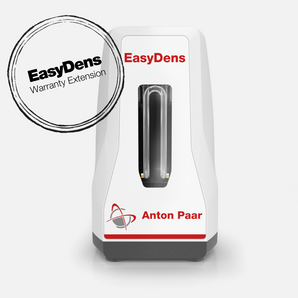
EasyDens: Digital Density Meter
Direct ABV measurement for distilled spirits.
- ±0.5 %v/v accuracy
- Fermentation tracking

pH2Go: Digital pH Meter
pH control during mashing and fermentation, avoiding unwanted harshness or microbial issues.
- ±0.02 pH accuracy
- Promoting healthy yeast activity
Fast, Easy ABV Measurements for a Smarter Workflow with the Proof Meister App
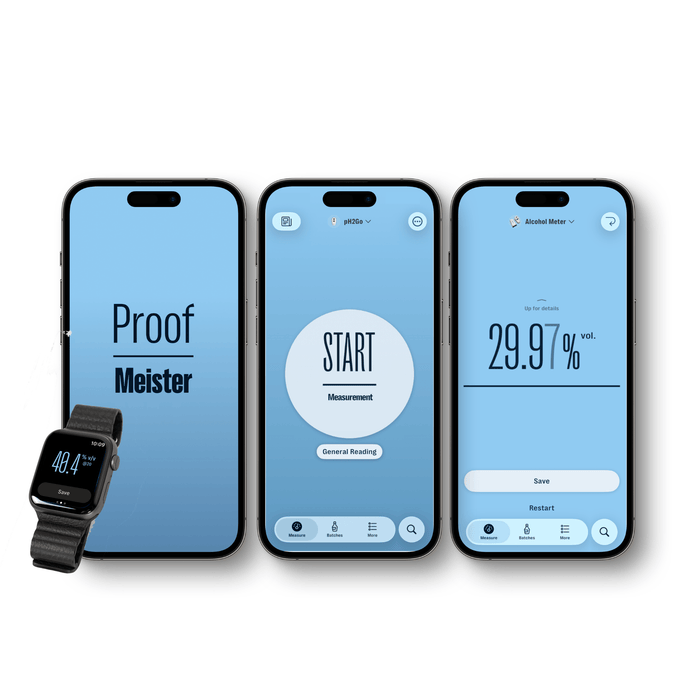
The Proof Meister app connects seamlessly to your devices via Bluetooth® Low Energy and brings ABV, extract, and pH measurements directly into your workflow. Start measurements instantly and choose from a wide range of units to match your application - clear, efficient, and built for everyday use. A guided interface leads step by step for reliable, reproducible results at your fingertips. Every reading is cloud-synced across iOS, Android, and web. Compare batches, share with a colleague, and pick up wherever you left off. Export to print-ready PDF or CSV the moment you need batch records, compliance documentation, or internal quality control.
Supported Measurement Units for Spirits & Liqueurs
EasyDens Measurement Units for Spirits:
- Alcohol Proof (°Proof UK)
- Alcohol Proof (°Proof US)
- Alcohol by volume (%v/v @15)
- Alcohol by volume (%v/v @20)
- Alcohol by volume (%v/v)
- Alcohol by weight (%w/w)
- Brix (°Bx)
- Density (g/cm³)
- Temperature (°C/°F)
pH2Go Measurement Units for Mashing:
- pH value
- Temperature (°C/°F)
Alcohol Meter Measuring Units for Liqueurs:
- Alcohol by volume (%v/v)
- Total extract (g/L)
- Temperature (°C/°F)
FAQs
Why can I measure the ABV of spirits with EasyDens alone, but need the Alcohol Meter for liqueurs?
Spirits such as vodka, whisky, or gin are mainly alcohol-water mixtures. For these samples, EasyDens can determine ABV directly from density, delivering reliable results. Liqueurs are more complex because they also contain sugar and other dissolved ingredients. These affect density and make ABV measurements by density alone less accurate. That is why the Alcohol Meter combines density from EasyDens with refractive index from SmartRef. Together, they enable accurate, temperature-compensated ABV results, even for complex samples such as liqueurs.
Which types of liqueurs can be measured with the Alcohol Meter?
You can measure clear liqueurs with the Alcohol Meter. Suitable examples include limoncello, amaretto, triple sec, fruit liqueurs, herbal liqueurs, schnapps-style liqueurs, and clear bitter or aperitif liqueurs. Liqueurs that contain cream, milk, egg, or similar ingredients are not suitable for measurement with the Alcohol Meter.
Why is pH important in creating spirits?
pH matters because it affects enzyme activity during mashing and yeast performance during fermentation, which directly influences how efficiently sugars are converted into alcohol. Keeping pH under control also helps reduce unwanted microbial activity and supports more consistent production.
What’s the difference between alcohol values reported as %v/v, %v/v @15, and %v/v @20?
- %v/v shows the alcohol content by volume at the actual sample temperature. No temperature correction is applied.
- %v/v @20 is temperature-compensated to 20 °C. Even if your sample is warmer or cooler, the result is standardized to this reference - making it ideal for consistent comparison.
- %v/v @15 works the same way as (%v/v @20) but uses 15 °C as the reference.
Explore our devices